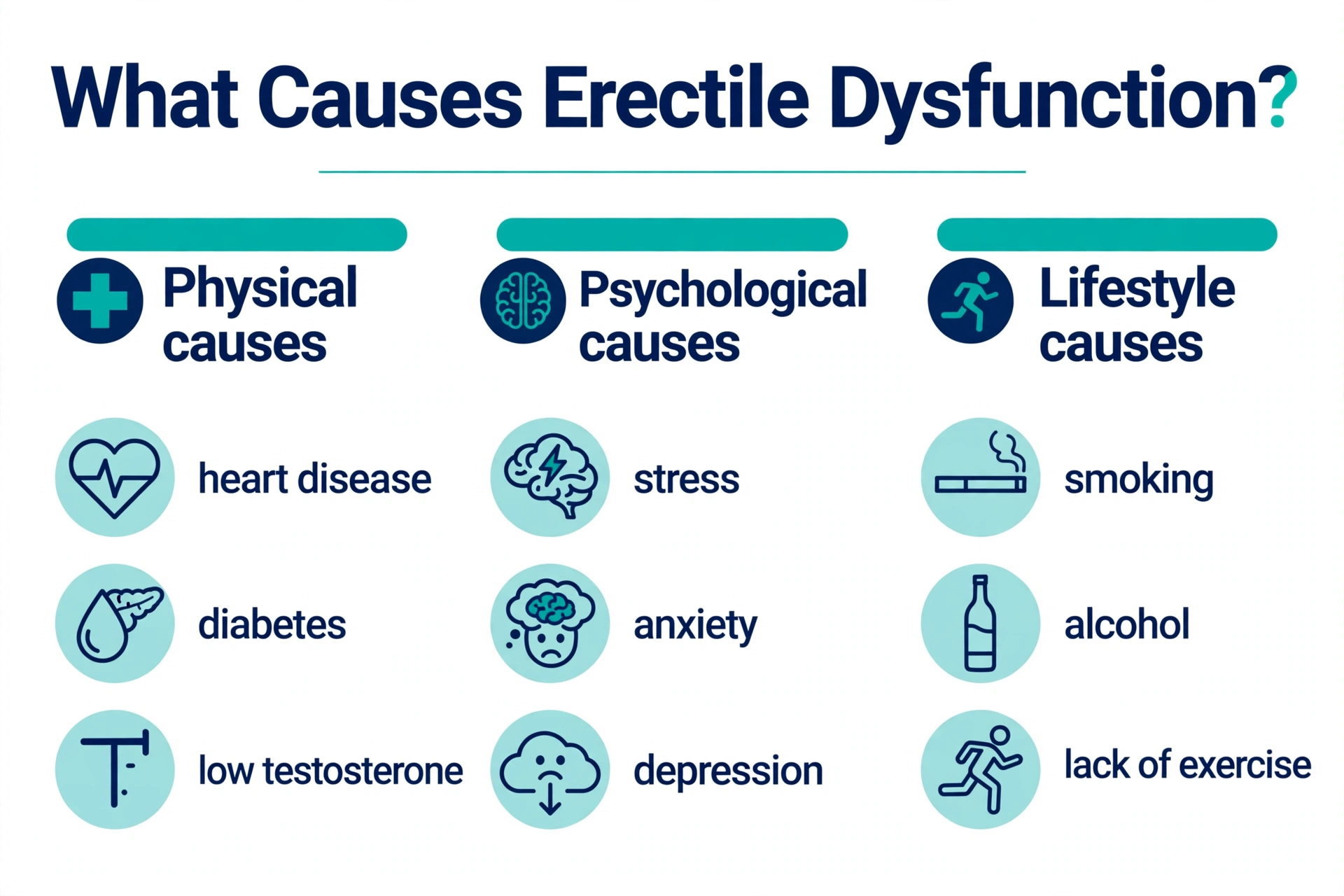
ED and Heart Disease
ED and heart disease share the same root problem: unhealthy blood vessels. The arteries that supply the penis are very small — about 1 to 2 millimetres wide — while the arteries of the heart are much larger. That means the same plaque and stiffening that will one day affect the heart often shows up first in the penis. Studies have found that men with ED, especially in their 40s and 50s, have a higher risk of heart attack and stroke in the years that follow than men without ED.
That sounds alarming, but it is also useful. ED can be the warning that gets a man to a doctor years before a heart problem would have been found. A doctor who sees a man for ED will usually check his blood pressure, cholesterol, blood sugar, and weight, and ask about smoking and exercise — the same checks that assess heart risk.
Is ED a sign of heart disease? Not always. Many men with ED have healthy hearts, and many men with heart disease never have ED. But the link is strong enough that new ED, especially with no obvious psychological cause, should be taken seriously — not just treated as a bedroom problem, but checked as a health problem.
The good news is that the same changes that help the heart help erections: stopping smoking, regular exercise, a healthy weight, controlling blood pressure and cholesterol, and managing blood sugar. These do not fix ED overnight, but they improve the blood flow that erections depend on, and they lower heart risk at the same time.
ED and Diabetes
Diabetes is one of the strongest causes of ED. Men with diabetes develop ED earlier, more often, and more severely than men without it. The reasons are twofold: diabetes damages both the blood vessels and the nerves that an erection needs, and it often comes with the other risk factors — obesity, high blood pressure, and high cholesterol — that make things worse.
Can diabetes cause ED? Yes. Over years of high blood sugar, small blood vessels narrow and nerves lose their ability to carry signals properly. That damage builds up slowly, so ED in a man with diabetes often starts gradually: erections become less firm, then less reliable, then absent.
If you have diabetes and ED, the most important step is not an ED treatment alone — it is getting blood sugar, blood pressure, and cholesterol under control, with your doctor’s help. Good control slows further damage, and some men see their erections improve as their overall health improves. But the damage already done may not fully reverse, which is why many men with diabetes need an ED treatment as well as better diabetes control.
ED can also be the first sign that a man has diabetes and does not know it. If ED appears along with frequent urination, constant thirst, unexplained weight loss, or slow-healing wounds, a doctor should check blood sugar. That check is simple and it matters far beyond erections.
Our guide to diabetes and ED is covered in more depth in the cluster post “Diabetes and ED: Understanding the Connection”.
ED and Low Testosterone
Testosterone is the hormone that drives sex drive, and it supports erections. When testosterone is low — a condition doctors call hypogonadism — desire usually drops first, and erections become weaker and less frequent. Morning erections often disappear too.
But low testosterone is often blamed for ED more than it deserves. Most men with ED have normal testosterone. Low testosterone becomes a likely cause when the pattern fits: low desire, low energy, loss of muscle, mood changes, and weak erections together, rather than erection problems alone.
Testosterone can be low for many reasons: ageing, obesity, type 2 diabetes, sleep apnoea, certain medicines (including some opioids and steroids), and problems with the testes or the pituitary gland. A blood test, taken in the morning when testosterone is highest, is how doctors check it — a single low reading is usually repeated before any decision is made.
Testosterone treatment is not a general ED treatment. It helps when testosterone is genuinely low and is causing symptoms; it does little for erections when testosterone is normal. It also has risks and needs monitoring, so it is a decision for a doctor, not a supplement to buy online. If low testosterone is suspected, the right step is testing, not guessing.
ED and Prostate Problems
The prostate sits close to the nerves and blood vessels that control erections, so prostate problems and their treatments are a common cause of ED.
Enlarged prostate (BPH). An enlarged prostate itself does not usually cause ED, but the two conditions share the same risk factors — age, obesity, lack of exercise — so they often appear together. Some medicines used for an enlarged prostate can affect erections and ejaculation, which is covered in the medicines section below.
Prostate surgery. Surgery to remove the prostate, usually for prostate cancer, is one of the most common causes of sudden ED. The nerves that control erections run very close to the prostate, and even with nerve-sparing surgery they can be bruised or damaged. Erections often return gradually over months to two years as the nerves recover, and rehabilitation — including medicines and other treatments — can help during that time. This is a slow process, and men who have had prostate surgery should discuss it with their surgeon and their doctor, not expect a quick fix.
Prostatitis and pelvic pain. Inflammation of the prostate and chronic pelvic pain can cause ED, often through pain, anxiety, and the medicines used to treat them. Treating the underlying problem usually helps the erections too.
Prostate cancer treatment. Radiation to the pelvis can damage blood vessels and nerves over time, so ED can appear months or years after treatment. Hormone therapy for prostate cancer lowers testosterone deliberately, which usually lowers desire and erections for as long as the therapy continues.
If ED starts after any prostate treatment, tell the doctor who did the treatment. They will know what was done and what recovery to expect, and they can plan the right next steps with you.
Medications That Cause ED
Some of the most widely used medicines in the world can cause ED as a side effect. That does not mean you should stop taking them — stopping a heart or blood pressure medicine suddenly can be dangerous. It means you should talk to the doctor who prescribed them, because there is often an alternative.
The main groups are:
- Blood pressure medicines. Some beta-blockers and diuretics (“water pills”) are the most commonly reported. Other blood pressure medicines, such as ACE inhibitors and calcium channel blockers, are less likely to cause problems.
- Antidepressants. SSRIs and some other antidepressants commonly affect desire, erections, and ejaculation. Depression itself also causes ED, so the cause is not always the medicine alone.
- Medicines for an enlarged prostate. Finasteride and dutasteride can lower desire and cause erection problems in some men. Tamsulosin and similar drugs are more likely to affect ejaculation than erections.
- Antihistamines and stomach medicines. Some older antihistamines and some acid-reducing medicines can contribute.
- Opioid painkillers. Long-term opioid use lowers testosterone, which can cause ED.
- Hormone treatments and steroids. Treatments that lower testosterone, and anabolic steroids, can both cause ED.
- Recreational drugs. Alcohol, cannabis, cocaine, and other drugs can cause or worsen ED, especially with regular use.
If you think a medicine is causing your ED, do not stop it on your own. Make a list of everything you take — including over-the-counter medicines and supplements — and take it to your doctor. A change of medicine, a lower dose, or a different drug in the same group often solves the problem without losing the benefit of the treatment.
Venous Leak: When Blood Escapes Too Fast
An erection works by trapping blood inside the penis. Blood flows in, and the veins that would normally drain it away are compressed shut. A venous leak is when those veins do not close properly, so blood escapes as fast as it arrives. The result is an erection that starts but fades quickly, or one that never becomes firm enough — even though desire and the initial signal are normal.
Venous leak can be caused by damage to the tissue that traps blood (from injury, Peyronie’s disease, diabetes, or surgery), or it can happen without a clear cause. It is more common in younger men than most people expect, and it is often missed, because routine tests do not show it.
Diagnosing a venous leak needs a specialist test — usually a Doppler ultrasound after an injection that causes an erection in the clinic, which measures blood flow in and out. It is not a test every doctor does, so if erections fade quickly and other causes have been ruled out, a referral to a urologist is the right step. Treatment depends on the cause: sometimes medicines or injections work well, sometimes a change of approach is needed, and surgery for venous leak is rarely the first choice and has mixed results.
If your erections start fine and then fade, do not assume it is “just anxiety” — it may be, but a venous leak looks exactly the same, and only testing can tell the difference.
ED by Age: 20s to 70s
ED looks different at every age, and so do its causes. This section is the hub — the detail for each decade is in our existing age guides, linked below.
In your 20s, ED is usually psychological or lifestyle-related: performance anxiety, stress, depression, pornography use, lack of sleep, heavy drinking, smoking, or recreational drugs. Physical causes are less common but not impossible — diabetes, hormone problems, and injury should still be checked if the problem persists.
In your 30s, the picture starts to change. Stress and relationship problems are still common, but early vascular risk factors — weight gain, high blood pressure, high cholesterol, and early diabetes — begin to appear. This is the decade when the habits that will shape the next thirty years are set.
In your 40s, vascular causes become more common, and ED often appears alongside the first signs of heart risk. Low testosterone begins to fall in some men. This is also the decade when ED is most useful as a warning sign: a man in his 40s with new ED should have his heart risk checked.
In your 50s, ED is common — roughly half of men in their 50s have some degree of it. Vascular disease, diabetes, prostate problems, and medicines all contribute. Treatments are usually effective, and finding the cause still matters, because the same checks protect the heart.
In your 60s, ED is very common, and the causes are usually a mix of several physical factors at once. That does not mean nothing can be done — treatments, including injections, work well at this age, and many men in their 60s and 70s have a satisfying sex life with the right treatment.
In your 70s and beyond, ED is widespread, but it is still not inevitable, and it is still worth treating if it matters to you. The same rule applies at every age: find the cause, treat what can be treated, and choose a treatment with your doctor.
Age guides: ED in your 30s · ED in your 40s · ED in your 50s · ED in your 60s.
ED Symptoms and How Long It Lasts
The symptoms of ED are straightforward, but men often wait a long time before mentioning them. The main ones are: trouble getting an erection, trouble keeping one, erections that are not firm enough, and erections that fade too quickly. Reduced desire and fewer morning erections often go with them. What matters is the pattern — occasional trouble is normal, regular trouble over weeks or months is ED.
How long does ED last? That depends entirely on the cause. ED from stress or a new medicine can resolve in weeks once the cause is dealt with. ED from diabetes or vascular disease is usually long-term, but it can improve with treatment of the underlying condition and with ED treatment. ED after prostate surgery often improves slowly over one to two years. There is no single answer, and anyone who promises a permanent cure in days is not being honest with you.
What does not help is waiting in silence. ED rarely gets better on its own when the cause is physical, and the longer it goes on, the more it affects confidence, mood, and relationships. The men who do best are the ones who bring it up early — with a partner, and with a doctor.
Related guides: ED symptoms · How long does ED last.
How Is ED Evaluated?
An evaluation for ED is simpler than most men expect, and it is private. It usually takes one or two visits.
First, the doctor asks questions: how long it has been happening, whether you can get an erection at all, whether morning erections still happen, how your desire is, what medicines you take, and about your general health — heart, blood pressure, diabetes, mood, sleep, smoking, drinking, and exercise. The doctor will also ask about your relationship and your stress levels. These questions are not judgement; they are how the cause is found.
Second, a physical examination: blood pressure, weight, a check of the penis and testes, and a check for signs of hormone problems. It is brief and matter-of-fact.
Third, blood tests: blood sugar, cholesterol, and testosterone (taken in the morning) are the usual ones. Thyroid and other hormone tests are added if the story suggests them.
Further tests are only done if they would change the plan: a Doppler ultrasound to check blood flow, an overnight erection test, or a referral to a urologist. Most men do not need them.
The point of the evaluation is not to label you — it is to find what is treatable. Sometimes that is a medicine to change. Sometimes it is blood sugar or blood pressure to control. Sometimes it is a treatment for ED itself. And sometimes the most important finding has nothing to do with erections at all: undiagnosed diabetes, high blood pressure, or heart risk that needed finding anyway.
When to See a Doctor
See a doctor promptly if any of these apply:
- ED has lasted more than a few weeks, or it is getting worse.
- You have ED and you also have diabetes, heart disease, high blood pressure, or high cholesterol — or you have never had these checked.
- You have chest pain, breathlessness, or leg pain on walking, with or without ED.
- ED started suddenly after an injury, surgery, or a new medicine.
- You have a curved penis, a lump, or pain in the penis.
- You have no morning erections at all and no desire — this can point to a hormone problem.
- ED is affecting your mood, your sleep, or your relationship.
- You are thinking of buying ED treatment online without a prescription or an evaluation — a doctor can tell you what is safe for you and what is not.
Go to the emergency room, or call emergency services, if you have an erection lasting more than four hours. That is priapism, and it is a medical emergency whether or not you used any treatment.
You do not need to be embarrassed. Doctors hear about ED every day, and they would much rather hear about it early, when the cause is easiest to find and treat, than late, when it has become a bigger problem.
What Treatments Exist? A Brief Overview
There is no single treatment for ED, because there is no single cause. Treatment follows the cause, and it usually follows a step-up pattern: start with the simplest, least invasive option that is likely to work, and move up only if it does not.
Lifestyle and treating the cause. Stopping smoking, regular exercise, weight loss, better sleep, less alcohol, and controlling blood pressure, cholesterol, and blood sugar help erections in many men, and they help the heart too. Changing a medicine that causes ED, where possible, can fix the problem without any ED treatment at all. Counselling or sex therapy helps when anxiety, depression, or relationship problems are a major part of the picture.
Oral medicines. Pills such as sildenafil (Viagra), tadalafil (Cialis), vardenafil, and avanafil increase blood flow to the penis. They work for many men, they are the usual first treatment, and they need sexual stimulation to work. They do not work for everyone, and they are not safe for everyone — notably, they must not be taken with nitrate medicines for chest pain.
Vacuum devices and other non-drug options. A vacuum pump draws blood into the penis and a ring holds it there. It is drug-free and works for many men, although some find it awkward. Urethral suppositories and low-intensity shockwave therapy are other options your doctor may discuss.
Penile injections — Trimix, Bimix and Quadmix. When pills do not work well enough, injections are often the next step. A very fine needle delivers medicine directly into the penile tissue, producing an erection in minutes. Trimix is the most commonly used blend. This is a prescription-only treatment, and your prescriber sets your dose and formula.
Related guides: Trimix dosage and injection guide · How to get Trimix online · Trimix safety and side effects.
Other options. Testosterone treatment helps only when testosterone is genuinely low. Penile implants are a surgical option when other treatments do not work or are not suitable. These are decisions to make with a urologist, not on your own.
The full comparison — pills, injections, pumps, implants, and how to choose between them — is in our treatments guide, not repeated here.
No treatment on this page is recommended for you personally. What works depends on your cause, your health, and your preferences, and that is a conversation to have with a licensed provider after an evaluation.